


· By Emily Imblum
GLP-1 and CGM: Why Ozempic Users Are Turning to the Dexcom Stelo (2026 Guide)

If you've started Ozempic, Wegovy, Mounjaro, or any other GLP-1 medication — or you're thinking about it — there's a question worth asking that most people aren't: how will you actually know if it's working?
Your next A1C check might be three to four months away. Your doctor's appointment even longer. In the meantime, you're injecting a powerful medication weekly, changing what you eat, and hoping the numbers are moving in the right direction.
This is exactly where a continuous glucose monitor (CGM) changes the game — and why, in 2026, a growing wave of GLP-1 users are pairing their medication with a wearable glucose biosensor. The newest option is the Dexcom Stelo, the first CGM you can buy over the counter without a prescription, specifically designed for the GLP-1 generation.
Here's everything you need to know.
- GLP-1 medications (Ozempic, Wegovy, Mounjaro, Zepbound) lower blood sugar by slowing digestion and boosting insulin response
- A CGM lets you see those glucose changes in real time — not just every few months via an A1C
- Dexcom data shows CGM use nearly quadrupled among non-insulin users after starting a GLP-1
- The Dexcom Stelo is the first OTC CGM — no prescription needed, $99 for a 30-day supply
- Stelo is designed for adults not on insulin, including people on GLP-1s, type 2, and prediabetes
- Decorative patch accessories help keep your Stelo on comfortably for its full 15-day wear
What Are GLP-1 Medications?
GLP-1 stands for glucagon-like peptide-1 — a hormone your body naturally produces in the small intestine after you eat. It signals the pancreas to release insulin, suppresses the glucagon that would otherwise raise blood sugar, slows how quickly your stomach empties, and tells your brain you're full.
GLP-1 receptor agonists are medications that mimic this hormone — amplifying its effects. They've been used for type 2 diabetes management for nearly two decades, but the last few years have put them squarely in the mainstream as their effectiveness for weight loss became widely recognized.
The most commonly recognized GLP-1 medications as of 2026 include:
| Brand Name | Active Ingredient | Primary Use | Administration |
|---|---|---|---|
| Ozempic | Semaglutide | Type 2 diabetes | Weekly injection |
| Wegovy | Semaglutide (higher dose) | Weight management | Weekly injection or pill |
| Mounjaro | Tirzepatide (dual GIP/GLP-1) | Type 2 diabetes | Weekly injection |
| Zepbound | Tirzepatide (higher dose) | Weight management | Weekly injection |
| Trulicity | Dulaglutide | Type 2 diabetes | Weekly injection |
| Rybelsus | Semaglutide | Type 2 diabetes | Daily pill |
All of these work by enhancing your body's natural glucose regulation — which is why pairing them with a device that shows you your glucose in real time is such a logical combination.
Why GLP-1 Users Are Turning to CGMs
Here's the problem with managing GLP-1 therapy without glucose monitoring: you're essentially flying blind between appointments.
A GLP-1 doesn't work the same way for everyone. The same dose of semaglutide will produce different glucose responses in different people depending on their diet, activity level, stress, sleep, and individual metabolism. The only way to understand how your body is responding is to measure it — and an A1C blood test three months from now doesn't give you that feedback loop.
The data tells a consistent story: seeing your glucose in real time changes behavior, and behavior change is exactly what makes GLP-1 therapy most effective. When you can watch your glucose curve flatten after a meal because of how you timed a walk or adjusted a food choice — that feedback loop accelerates results.
The Dexcom Stelo: The CGM Built for the GLP-1 Era
Until recently, CGMs required a prescription and were primarily designed for people managing insulin therapy. That changed in March 2024 when the FDA cleared the Dexcom Stelo — the first over-the-counter continuous glucose biosensor in U.S. history.
Dexcom was explicit about who they built it for. As Dr. Thomas Grace, head of clinical advocacy at Dexcom, said at launch: "In a world where GLP-1 use is becoming increasingly more common, glucose biosensors like Stelo can help make those medications more effective."
📊 Dexcom Stelo — At a Glance
What makes Stelo different from prescription CGMs?
The Stelo is built on the same proven Dexcom G7 sensor technology that insulin-dependent users have relied on for years. The main differences are in the software experience and the user it's designed for. Prescription CGMs like the G7 are calibrated with alarms and alerts tailored to insulin users who need to act fast on dangerous lows. The Stelo strips those away and replaces them with a more approachable, lifestyle-oriented interface — glucose trends, spike detection, meal and activity logging, and weekly summary insights.
The result is a device that's powerful enough to show you exactly how your GLP-1 is working, without the clinical intensity of a full prescription CGM.
What to Expect When You Start Wearing a Stelo on a GLP-1
For most GLP-1 users who start wearing a Stelo, the first week is genuinely eye-opening. Here are the most common things people notice:
Your "safe" foods may not be as safe as you think
Oatmeal. Whole grain toast. Fruit smoothies. These foods are widely considered healthy, and they are — but for some people, they still produce significant glucose spikes. A CGM shows you which of your go-to foods are still working against you even on medication, and which combinations (like adding protein or fat) flatten that curve dramatically.
Timing matters more than you expected
A short 10-minute walk after dinner can lower your next-morning fasting glucose. Eating at 9pm versus 6pm shows up clearly in your overnight graph. Stress at work raises your glucose with no food involved whatsoever. These aren't things anyone tells you about GLP-1 therapy — but a CGM shows them to you in real time, every day.
You can actually see the medication working
One of the most motivating things Stelo users on GLP-1s report is being able to literally see their post-meal spikes shrink over weeks of therapy. Instead of waiting three months for an A1C result, you can watch the trend in your app and know the medication is doing its job — or identify early if a dose adjustment conversation with your doctor is warranted.
Sleep and stress show up as glucose events
A bad night's sleep can raise fasting glucose by 20-30 mg/dL the next morning, even with perfect diet and medication adherence. Chronic stress produces measurable glucose elevation throughout the day. Seeing these connections clearly tends to motivate behavioral changes that amplify everything your GLP-1 is already doing.
Wearing Your Stelo Comfortably — And Making It Yours
The Stelo goes on the back of the upper arm and stays there for 15 days straight. Through showers, workouts, sleep, and everything else in your life. For most people that's straightforward — but there are a few things that make the experience noticeably better.
Skin prep before application
Wash the site with soap and water, let it dry completely, and avoid applying lotion or sunscreen to that specific spot before placing your sensor. Clean, oil-free skin makes the biggest difference in how long the adhesive holds.
Press and hold on application
After placing your Stelo, press the adhesive patch firmly with the heel of your hand for 30 seconds, working around the edges. This activates the bond and dramatically reduces early edge lifting.
Give it an hour before your first shower or workout
The adhesive needs time to fully bond before its first major moisture exposure. Applying before bed on the night before a workout day is an easy habit to build.
Make it part of your look
This is where things get personal. A lot of people on GLP-1s are new to wearing medical devices — and wearing something on your arm 24/7 for 15 days is an adjustment. One thing that genuinely helps is making the device feel like a choice rather than something you're stuck with.
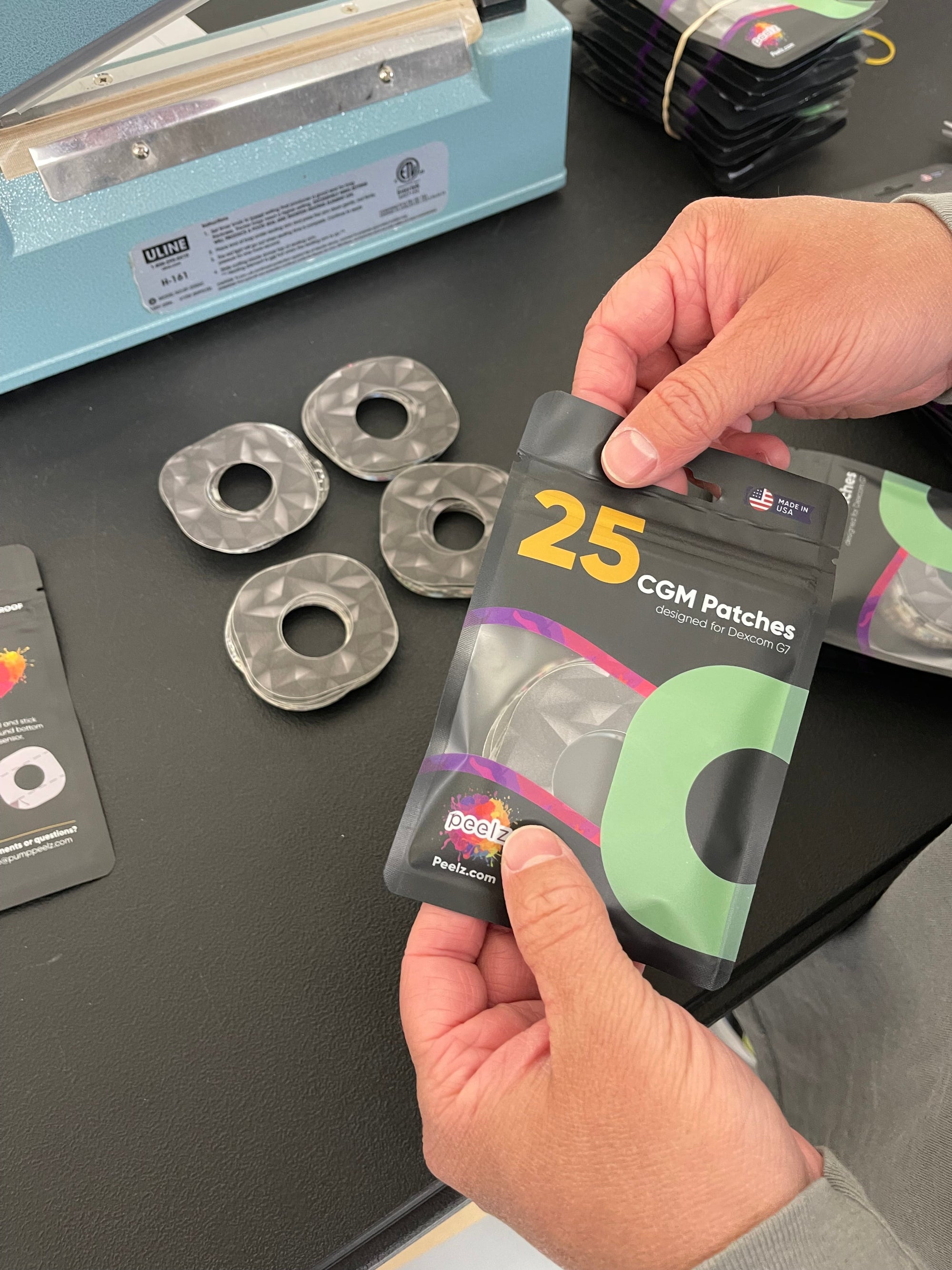
Pump Peelz decorative patch accessories are non-medical overlays worn over and around compatible CGM sensors like the Stelo. They cover the sensor edges, reduce lifting during daily wear, and come in hundreds of designs — so your sensor reflects your personality rather than disappearing into clinical beige. Whether you want bold patterns, subtle neutrals, or a seasonal design, there's something that fits how you want to show up in the world while you're doing the work of getting healthier.
Shop Decorative Stelo & Dexcom G7 Patch Accessories
Non-medical decorative patches worn over and around compatible Stelo and Dexcom G7 sensors. 500+ designs. Made for real life.
Shop G7 & Stelo Patches Shop Variety PacksFrequently Asked Questions
Should I use a CGM while taking Ozempic or Wegovy?
Many healthcare providers recommend pairing CGM with GLP-1 therapy because it gives you real-time visibility into how the medication is affecting your glucose — instead of waiting months for an A1C result. A Dexcom analysis found CGM use nearly quadrupled among non-insulin users after starting a GLP-1. Talk to your healthcare provider about whether a CGM is appropriate for your situation.
What is the Dexcom Stelo and who is it for?
The Dexcom Stelo is the first FDA-cleared over-the-counter glucose biosensor in the U.S. It's designed for adults 18 and older who don't use insulin — including people with type 2 diabetes on oral medications or GLP-1s, people with prediabetes, and anyone who wants to understand how their lifestyle affects their glucose. No prescription required. $99 for a 2-pack (30-day supply), HSA/FSA eligible.
How long does the Dexcom Stelo last?
Each Stelo sensor lasts up to 15 days — the longest biosensor wear time on the market. A 2-pack gives you up to 30 days of continuous monitoring. The sensor is waterproof, worn on the back of the upper arm, and never requires a fingerstick.
Do I need a prescription for the Dexcom Stelo?
No. The Stelo is available directly at Stelo.com without a prescription. It is not for people on insulin therapy or people who experience problematic hypoglycemia.
Can GLP-1 medications cause low blood sugar?
GLP-1 receptor agonists on their own have a low risk of hypoglycemia because they work in a glucose-dependent way — they stop boosting insulin once blood sugar normalizes. However, when combined with other glucose-lowering medications, the risk can increase. Always discuss hypoglycemia risk with your healthcare provider given your full medication regimen. The Dexcom Stelo is not intended for people with problematic hypoglycemia.
Are there decorative patches for the Dexcom Stelo?
Yes. Pump Peelz makes decorative, non-medical patch accessories compatible with the Dexcom Stelo. These are worn over and around the sensor for personalization and do not alter sensor function. Available in hundreds of designs at PumpPeelz.com.
Related Reading
- Dexcom G7 Complete Guide: Everything You Need to Know in 2026
- How to Keep Your CGM On: 10 Proven Tips
- Living with Diabetes in 2026: A Complete Guide